
Hair loss, medically evaluated. Evidence-based options — matched to cause and goal.
Most men walk into a hair-loss clinic and walk out with a five-figure procedure quote. Dr. Castellano starts somewhere different — with the evidence ladder. Finasteride and minoxidil have FDA approval and decades of clinical data; PRP has emerging evidence and individualized response; surgery enters the conversation when medical management can’t reach the goal.
Garden Grove · Mon–Fri 9 AM – 5 PM

Hair loss has more than one cause. Most clinics check for one of them.
Genetic male-pattern is the most common driver, but it’s not the only one. The workup matters because the answer changes everything from the medication choice to whether medication is even the right tool.
- Genetic male-pattern thinning (DHT-driven — the most common cause)
- Low ferritin (iron stores) — quietly common in men who train hard
- Thyroid dysfunction (especially subclinical hypothyroidism)
- Vitamin D deficiency (very common in adults working indoors)
- Side effect of an unrelated medication (common offenders: certain antidepressants, blood pressure meds, some acne treatments)
- Recent illness, surgery, or major life stress (telogen effluvium)
- Traction from tight hairstyles (less common in men, but real)
- Genetic male-pattern thinning (DHT-driven — the most common cause)
- Low ferritin (iron stores) — quietly common in men who train hard
- Thyroid dysfunction (especially subclinical hypothyroidism)
- Vitamin D deficiency (very common in adults working indoors)
- Side effect of an unrelated medication (common offenders: certain antidepressants, blood pressure meds, some acne treatments)
- Recent illness, surgery, or major life stress (telogen effluvium)
- Traction from tight hairstyles (less common in men, but real)
Honest version: TRT can accelerate male-pattern thinning in men who were going to lose it eventually.
Most TRT clinics don’t bring this up because it complicates the sale. Dr. Castellano brings it up before either intervention starts — because if you’re considering TRT and you’re also genetically predisposed to thinning, the conversation changes. Sometimes the answer is starting Finasteride alongside TRT to blunt the acceleration. Sometimes it’s a different testosterone delivery method. Sometimes the trade-off is worth it; sometimes it’s not. Either way, the decision is yours to make with full information.
The same hormone panel evaluates both — testosterone levels for the TRT picture, DHT for the hair-loss picture. One visit, both questions answered.
Start cheap and evidence-based. Escalate only when warranted.
- 01
Medical evaluation
Hormone + ferritin + thyroid + vitamin D + comprehensive metabolic. Rule out the drivers nobody else has checked for.
- 02
Generic Finasteride
Oral DHT-blocker. FDA-approved. Generic. Strong evidence base for male-pattern thinning.
- 03
Generic Minoxidil
Topical or oral. FDA-approved. Generic-priced. Often paired with Finasteride for additive effect.
- 04
PRP if appropriate
Platelet-rich plasma injection series. Out-of-pocket. Realistic expectations and appropriate candidate selection — not a universal answer.
- 05
Surgical referral
For advanced thinning where medical management can't restore density, referral to a vetted local hair-restoration surgeon (FUE / FUT).
Generic Finasteride and Minoxidil are affordable, FDA-approved, and well-evidenced.
Both have been FDA-approved for male-pattern hair loss for decades, and the evidence behind them is strong. For most men, one or both is the right place to start.
When they aren’t enough on their own, Dr. Castellano adds options like PRP, which he offers here in the office, based on how your hair has responded so far.
Available, not pushed. Realistic expectations.
Platelet-rich plasma injection for hair loss uses growth factors from your own blood to support the follicles in areas of thinning. A small blood draw is spun in a clinical centrifuge to concentrate the platelets, and the resulting PRP is injected into the scalp at the thinning sites. Platelets carry more than twenty signaling proteins that direct cell growth, vascular development, and tissue repair — the same machinery the body uses to heal a cut, redirected to the hair follicle. PRP is offered here when the clinical picture supports it, generally as an adjunct to medical management rather than a replacement for it.
Six of the growth factors most relevant to follicle health.
- PDGFPlatelet-Derived Growth Factor
Promotes blood vessel growth and cell replication.
- VEGFVascular Endothelial Growth Factor
Promotes new blood vessel formation.
- EGFEpidermal Growth Factor
Supports cellular proliferation, differentiation, and survival.
- FGFFibroblast Growth Factors
Promotes growth of cells and blood vessels.
- IGFInsulin-like Growth Factors
Promotes cell growth and inhibits cell death.
- NGFNerve Growth Factor
Supports the proliferation and survival of certain neurons.
Monthly for three months, then once a year for maintenance.
At Castellano Health Institute the protocol runs monthly for three months, followed by one maintenance session per year. Visible response is typically seen at the one-month mark and continues to develop over the following three to six months. A 2017 literature review in Stem Cell Investigation concluded PRP is a simple, cost-effective, and feasible treatment option with high patient satisfaction for androgenic alopecia.
Published studies have shown PRP can grow new hair, increase hair thickness, and support hair regrowth in appropriate candidates — with results varying by responder. PRP is not a hair-restoration procedure and does not regrow hair where the follicles are already dormant or absent. Dr. Castellano evaluates each patient against the responder profile before recommending the protocol, and is honest when the better answer is to stay on the medical-management lane.
What PRP is good for.
- No risk of allergic reaction
- No surgery required
- Uses your body's own growth factors
- Stimulates new hair growth
- Makes existing hair grow thicker
- Slows down hair loss
- No significant downtime
When PRP isn’t the right fit.
Dr. Castellano screens for these conditions in the initial evaluation, and refers out or adjusts the plan when PRP isn’t the right fit.
- Pregnancy or breastfeeding
- Cancer or on chemotherapy
- On immunosuppressive therapy
- Heavy smoker
- Chronic liver disease or heavy drinker
- On anti-coagulation therapy
- Hemophilia or other blood-clotting disorders
- Certain skin diseases / current skin infection
Real hairlines. Real timelines.
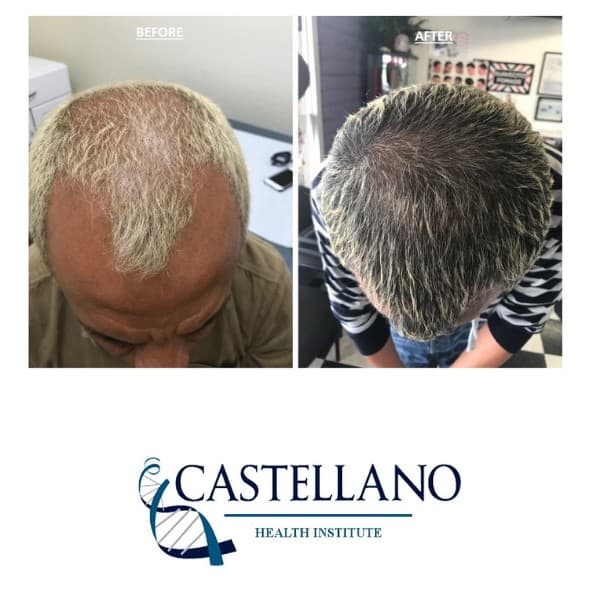
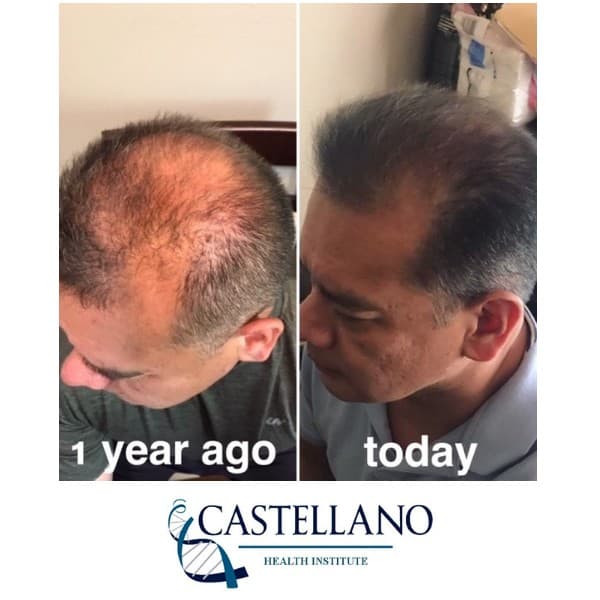
Individual results vary. Photos show real results with treatment consent on file.
Four steps. Labs-led, like everything else here.
- 01
Sit-down visit
1-hour, 1-on-1. Walk through the labs, look at the pattern of thinning, talk through the trade-offs.
- 02
Bloodwork
Hormone + ferritin + thyroid + vitamin D + metabolic panel. Same panel that anchors TRT.
- 03
Build the plan
Start with what works at the lowest cost. Add PRP if the picture supports it. Refer for surgery only when medical management can't reach the goal.
- 04
Recheck at 4–6 months
Hair growth is slow. The recheck is when we evaluate response, adjust the plan, and decide whether to escalate.

Hair loss is medical — and worth looking at.
Hair loss isn't just cosmetic, and it isn't just “genetics, nothing you can do.” It has real, identifiable medical drivers — hormonal, thyroid, nutritional, stress, medication — and many of them are worth identifying. Treated as medicine, it’s a problem worth evaluating, not just accepting.
Dr. Castellano approaches it the way a physician should: a real workup to find what’s actually driving it, then a plan matched to the cause, with labs and follow-up behind it — the kind of medical attention hair loss deserves and rarely gets.
The questions men actually ask before they call.
Don’t see yours? Call the office and ask Dr. Castellano directly.
Will I lose hair on TRT?
Do you do hair transplants?
Does Finasteride cause sexual side effects?
How long until Finasteride or Minoxidil shows results?
Is PRP for hair loss covered by insurance?
Can PRP regrow hair or make it thicker?
What if I'm already taking finasteride from another doctor?
Do you treat women with hair loss?
Real patients. Real reviews. Verified by Google.
Medical hair loss evaluation across the OC corridor.
The clinic sits on S Euclid St in Garden Grove — easy reach from Anaheim, Westminster, Santa Ana, and the wider OC corridor. Free on-site parking.
We see patients from Garden Grove, Anaheim, Westminster, Stanton, Santa Ana, Cypress, Buena Park, Orange, Fountain Valley, Huntington Beach, Costa Mesa, Tustin, Fullerton, Long Beach, Los Angeles, and across Orange County.
Book the 1-hour consult.
Bring whatever bloodwork you have on file. The hair-loss conversation starts with the labs that nobody else has run yet.
Mon–Fri 9 AM – 5 PM
Calling after hours? Leave a message — we’ll get back to you the next business day.